
When you click on a sponsoring school or program advertised on our site, or fill out a form to request information from a sponsoring school, we may earn a commission. View our advertising disclosure for more details.
“You are under whatever the regulatory environment is in Washington, D.C. at the moment…Lots of confusion, lots of challenges for all borrowers because of that, not just med lab students.”
– Kyle Riding, President of the American Society for Clinical Laboratory Science
Medical laboratory professionals are the unseen backbone of American healthcare. They analyze blood samples, run diagnostic tests, and generate data that inform an estimated 70 percent of medical decisions, according to figures cited by the CDC. Yet they remain one of the most overlooked workforces in the country. Today, that oversight is reaching a crisis point. The US is facing a serious and growing shortage of lab professionals, with demand far outpacing the number of trained graduates entering the field each year. And while there are many factors driving people away from or out of the profession, one keeps coming up again and again: student loan debt.
Training to become a medical laboratory scientist requires a four-year bachelor’s degree, often supplemented by specialized clinical rotations and national certification exams. It’s a rigorous, highly technical education, but the salaries waiting on the other end don’t always reflect that investment.
When nurses, physicians, and other healthcare professionals have access to a robust menu of federal loan-forgiveness programs that reward their service, lab professionals are largely left out. Only four major federal programs are available to them, and none were designed specifically for lab workers.
This disparity has sparked a growing advocacy movement among the organizations that represent lab professionals on Capitol Hill. Groups including the American Society for Clinical Laboratory Science (ASCLS), the American Society for Clinical Pathology (ASCP), and the Association for Diagnostics and Laboratory Medicine (ADLM) have been pushing Congress to extend loan forgiveness access to laboratory workers, most recently rallying support behind the bipartisan Medical Laboratory Personnel Shortage Relief Act of 2025.
Among those advocating for change is Dr. Kyle Riding, president of ASCLS, who says the path forward may already be written into existing law: “What ASCLS and other organizations have been really keen on trying to address is using some existing legislation, regulatory tools that are out there, particularly through the Public Health Service Act, that would help med lab students along with other allied health professionals to have some more direct routes to loan forgiveness that still make a sizable contribution to the nation and to the communities within which they serve,” Dr. Riding said.
Meet the Expert: Kyle Riding, PhD
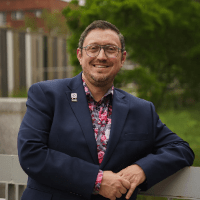
Dr. Kyle Riding is serving as president of the American Society for Clinical Laboratory Science for the 2025 to 2026 term, where he advocates for the visibility, support, and advancement of medical laboratory professionals nationwide. In this leadership role, he focuses on strengthening the professional community, addressing workforce challenges, and promoting initiatives that support inclusion and resilience within the field.
In addition to his national leadership, Dr. Riding is a clinical associate professor and program director at the University of New Hampshire, where he teaches courses across clinical laboratory science and biomedical topics and mentors students preparing for careers in laboratory medicine. Together, his work reflects a dual commitment to advancing the profession at a national level while educating the next generation of laboratory scientists.
Current Options For Med Tech Student Loan Forgiveness
For most medical laboratory students who take out federal loans, the primary path to relief is Public Service Loan Forgiveness (PSLF), a federal program that forgives remaining loan balances after 10 years of continuous payments while working for a qualifying nonprofit employer. Since most hospitals operate as nonprofits, many lab professionals technically qualify. But Dr. Riding, who has navigated the program himself, says qualifying is only part of the story.
“I can speak very clearly to that as someone with student loans myself, who’s worked in the industry and has navigated some of the complexities related to loan forgiveness in its current state,” he said. “The amount of money it costs to go into one of these programs is quite extensive compared to, say, other college degrees. It’s more aligned with nursing or other allied health specialties. You’re not able to work much because of the clinical requirements. There was one semester in undergrad when I was in a lab four afternoons a week and lectures five mornings a week. So it’s expensive, and our students are struggling to find time to work. They have to rely on loans a lot of times.”
And when PSLF is the primary safety net, it comes with strings attached. Dr. Riding points out that committing to 10 years at a nonprofit employer means forgoing potentially lucrative opportunities in the private sector, which can be a difficult trade-off for early-career professionals still figuring out where they want to take their careers.
“When you’re going to hope for Public Service Loan Forgiveness, a lot of times you are at a point in your career where you may want to go into industry,” he said. “You might want to consider going into the for-profit sector, because you can make an important and critical impact there as well, but you lose all of that potential savings in your loans.”
Beyond PSLF, options are limited. Lab professionals who transition into teaching may be eligible for HRSA’s Faculty Loan Repayment Program, which offers up to $40,000 in assistance for allied health faculty at accredited programs. And in California, the state’s Allied Healthcare Loan Repayment Program (AHLRP) offers targeted relief for allied health professionals who commit to serving patients in underserved counties. But these are narrow pathways, and most lab professionals across the country don’t qualify for either.
Adding to the frustration is the instability of the loan forgiveness landscape itself. “You are under whatever the regulatory environment is in Washington, D.C. at the moment,” Dr. Riding said, “and when it comes to student loans, that has been a very volatile space for the last 10 years, and most notably the last five to six. Lots of confusion, lots of challenges for all borrowers because of that, not just med lab students.”
Why Lab Professionals Have Been Left Behind
If the need is so clear, why has it taken so long for laboratory professionals to gain traction in the loan-forgiveness conversation? Dr. Riding points to a mix of structural and cultural factors: a smaller workforce, limited advocacy training, and a professional identity that has only recently solidified.
“We are a semi-smaller profession. We’re around 350,000 professionals strong, which is certainly not small, but it’s certainly not a nursing landscape by any stretch,” he said, noting that fewer voices can mean less policy visibility. He added that many students never receive formal exposure to advocacy, leaving professionals unaware of how influential their collective voice can be.
The field’s history also plays a role. Medical laboratory science developed as an allied health specialty within pathology and is younger than many comparable professions. Dr. Riding notes that widespread adoption of the “medical laboratory scientist” title at the bachelor’s level helped unify the profession, but that cohesion is relatively recent.
He sees the Covid-19 pandemic as a turning point. While devastating, it highlighted the essential role laboratory teams play in diagnosing disease, tracking outbreaks, and guiding treatment decisions, bringing new visibility to work that often happens behind the scenes.
That visibility matters because, as Dr. Riding emphasizes, lab professionals are not peripheral to care; they are foundational. “I think of healthcare as a team sport, and you can’t have a team playing on the field if you’re missing a role,” he said, pointing to responsibilities ranging from infectious disease testing to blood banking.
The consequences of shortages are already being felt. Dr. Riding describes hearing frequent stories of understaffed labs scrambling to cover shifts, underscoring how critical these roles are to keeping healthcare systems functioning day to day.
What the Medical Laboratory Personnel Shortage Relief Act Would Do
At the center of current advocacy efforts is the Medical Laboratory Personnel Shortage Relief Act of 2025 (H.R. 5444), bipartisan legislation supporters say could significantly expand the pipeline of future laboratory professionals by making training more financially accessible.
Dr. Riding believes the bill’s greatest impact would be psychological as much as financial. “If we can get the legislation … to cross the finish line and become law, I think that would make a tremendous impact on programs and their ability to recruit students,” he said. For prospective students, the promise of targeted loan relief could ease one of the biggest barriers to entering the field, while offering a shorter, more flexible service commitment than existing forgiveness pathways.
But legislation alone, he argues, is only part of the solution. Dr. Riding also points to the importance of restoring robust funding for the Health Resources and Services Administration (HRSA), which has historically supported multi-million-dollar grants to medical laboratory science programs. Those grants have helped schools expand enrollment, lower student debt burdens, and build a more diverse workforce equipped to serve both rural and urban communities.
Earlier federal funding decisions paused a new round of these grants, but Dr. Riding says reinstating them alongside targeted loan-forgiveness legislation would create a powerful one-two punch for workforce development. Together, he argues, policy support and program funding could give schools the resources to grow while giving students the confidence to enter the profession.
What Prospective Students Should Know Right Now
For students considering medical laboratory science as a career, Dr. Riding’s advice is grounded and direct: start with your why.
“I want you to understand the profession first. I want you to make sure this is the right fit for you, especially right now, given the policy landscape. We don’t necessarily know what’s going to change in federal, state, or local policy at any given point. That has been a very stark reality, particularly over the past 12 months,” he said. “So if they know their why, and the why is this is the profession I want to be in, and they work with us as faculty to identify scholarship opportunities, they understand sometimes loans are necessary. Not that we ever want to see people go into debt, but if their why is really driven to this, they won’t regret the investment they’re making in themselves.”
Dr. Riding is candid that medical laboratory science is not the right fit for everyone, and he’s unapologetic about saying so. He worries that some of the profession’s recruiting messaging leans too heavily on where an MLS degree can take you beyond the lab, rather than on the work itself.
“I am very much an advocate for making sure folks know about us as a profession, but I’m also of the firm belief that we are not the profession for everybody, and that’s okay,” he said. “We need to make sure our messaging as a profession isn’t ‘well, with this degree, you can become a doctor.’ I will support my grad if they decide to go down those routes, but I want to see them become medical lab scientists, because this profession has done so much for me and so many of the folks I know.”
For students who do find that the profession resonates with them, Dr. Riding says the uncertainty of today’s policy environment doesn’t have to be paralyzing. The loan forgiveness landscape may be shifting, legislation may be slow, and Washington may feel unpredictable, but none of that changes what the work actually is or why it matters.
“If that’s their why, this ever-changing policy landscape we’re in? That North Star doesn’t change, and you can navigate your boat around it at that point.”